Containment
Observe closed plates in the teaching setting; do not open or smell cultures.
 MEDIVEERSETHE PRACTICAL HUB
LOOK CLOSELY / UNDERSTAND CLEARLY
Recognise a culture plate and describe colonies without over-identifying an organism.
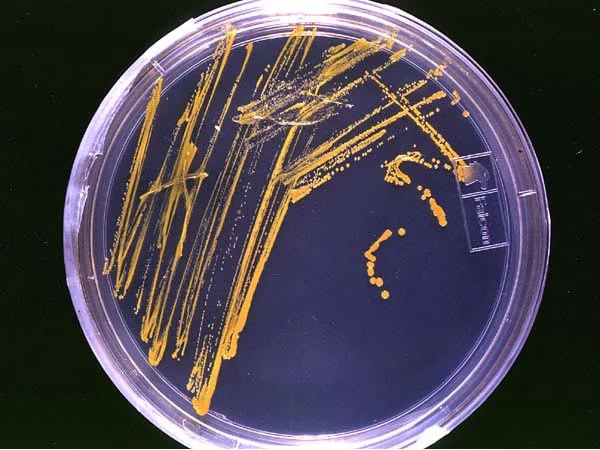
The solid growth medium within the plate.
Zoom in, then drag to inspect. Keyboard: + / − to zoom, arrows to pan, 0 to reset. Tap the numbered markers to explore parts.
culture plate — reference view
Image: Author credited at source · Source / original · Public domainResized and converted to WebP; original colours retained.
Appropriate culture conditions permit growth that can be characterised and tested in a controlled laboratory.
Observe closed plates in the teaching setting; do not open or smell cultures.
Record colony appearance only when supported by the actual specimen.
Confirm with validated laboratory methods, not colony colour alone.
Try answering aloud, then open the suggested answer. Examiner questions vary.
No. Many organisms and media can produce similar appearances.
To maintain containment and reduce contamination or exposure.
A discrete growth area used in a controlled laboratory workflow.
No. Collection site, contamination and transport affect interpretation.