 MEDIVEERSETHE PRACTICAL HUB
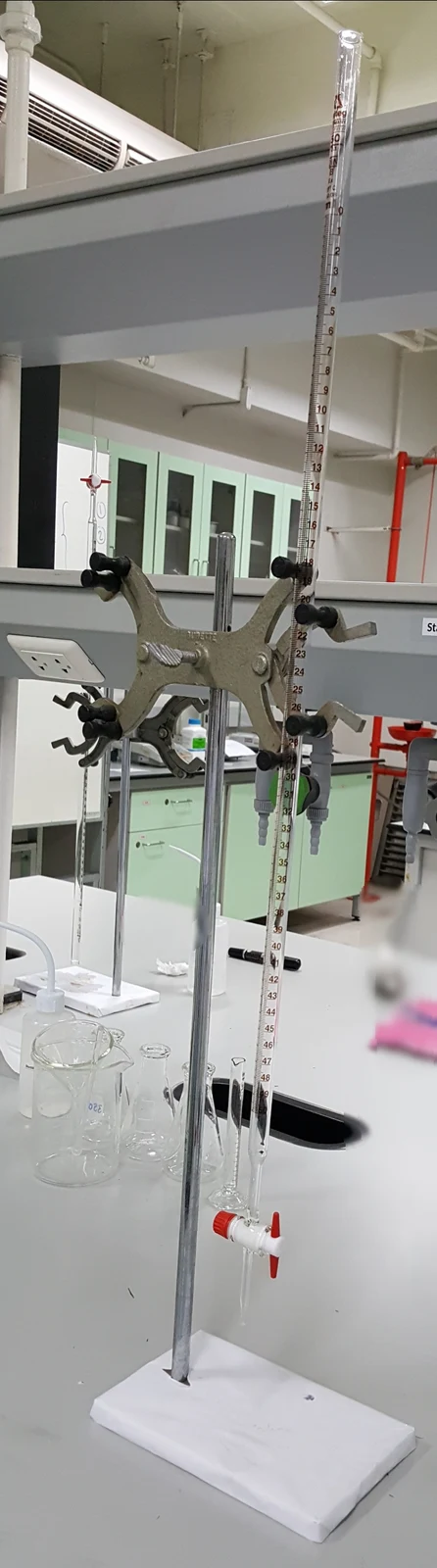
Initial and final scale readings determine delivered volume; avoid parallax when reading the meniscus.
Zoom in, then drag to inspect. Keyboard: + / − to zoom, arrows to pan, 0 to reset. Tap the numbered markers to explore parts.
Burette — reference view
Image: Chanunchida.suthi · Source / original · CC BY-SA 4.0Resized and converted to WebP; original colours retained.
Burette
Buret · titration tube
What is its use?
Delivers a measured variable volume during titration.
Tap a number to locate its part. Zoom, drag or use full screen to inspect the reference. Models and graduations can differ; check the actual apparatus used in your laboratory.
How to recognise it.
- Long graduated tube
- Flow-control tap near the bottom
- Fine delivery tip
A burette controls gradual addition; a volumetric pipette transfers a fixed volume.
Point them out.
Choose a part to bring its numbered marker into view.
The science behind the reading.
Delivered volume is obtained from the difference between initial and final scale readings.
Think first. Then reveal.
Explain your answer aloud before opening it.
01Why remove air from the tip?+
An air bubble can make the indicated delivery differ from the volume reaching the flask.
02Is the endpoint always the equivalence point?+
No. The endpoint is the observed signal; the equivalence point is the stoichiometric condition.
03How is the titre obtained?+
Final reading minus initial reading, using the same scale and reading convention.
04Why read at eye level?+
To minimise parallax error.
Read the references.
Teaching and clinical references are listed here. Image attribution and licence appear below the viewer.