Identify
Distinguish curved and straight blade designs.
 MEDIVEERSETHE PRACTICAL HUB
LOOK CLOSELY / UNDERSTAND CLEARLY
Recognise laryngoscope blades and explain their role in airway visualisation.
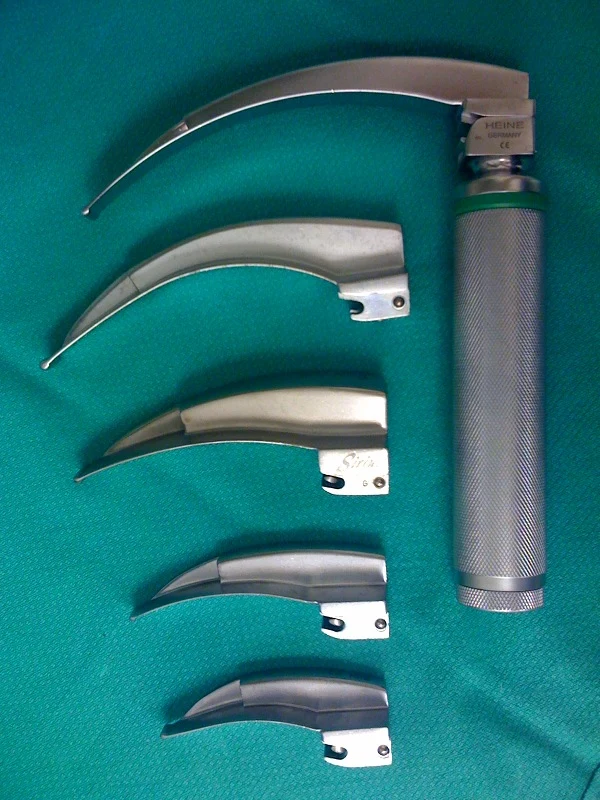
A curved Macintosh-type blade in this reference set.
Zoom in, then drag to inspect. Keyboard: + / − to zoom, arrows to pan, 0 to reset. Tap the numbered markers to explore parts.
laryngoscope — reference view
Image: Sasata (talk) · Source / original · CC BY 3.0Resized and converted to WebP; original colours retained.
A blade and illumination system improve the line of sight to laryngeal structures in the intended procedure.
Distinguish curved and straight blade designs.
Recognise the need for compatible components, functioning illumination and an airway plan.
This is supervised airway equipment, not an instrument for unsupervised throat examination.
Try answering aloud, then open the suggested answer. Examiner questions vary.
No. Curved and straight designs serve different approaches.
No. Placement must be confirmed using the approved clinical methods, including appropriate capnography.
Failure during airway care can be time-critical.
No. It provides indirect reflected examination.