 MEDIVEERSETHE PRACTICAL HUB
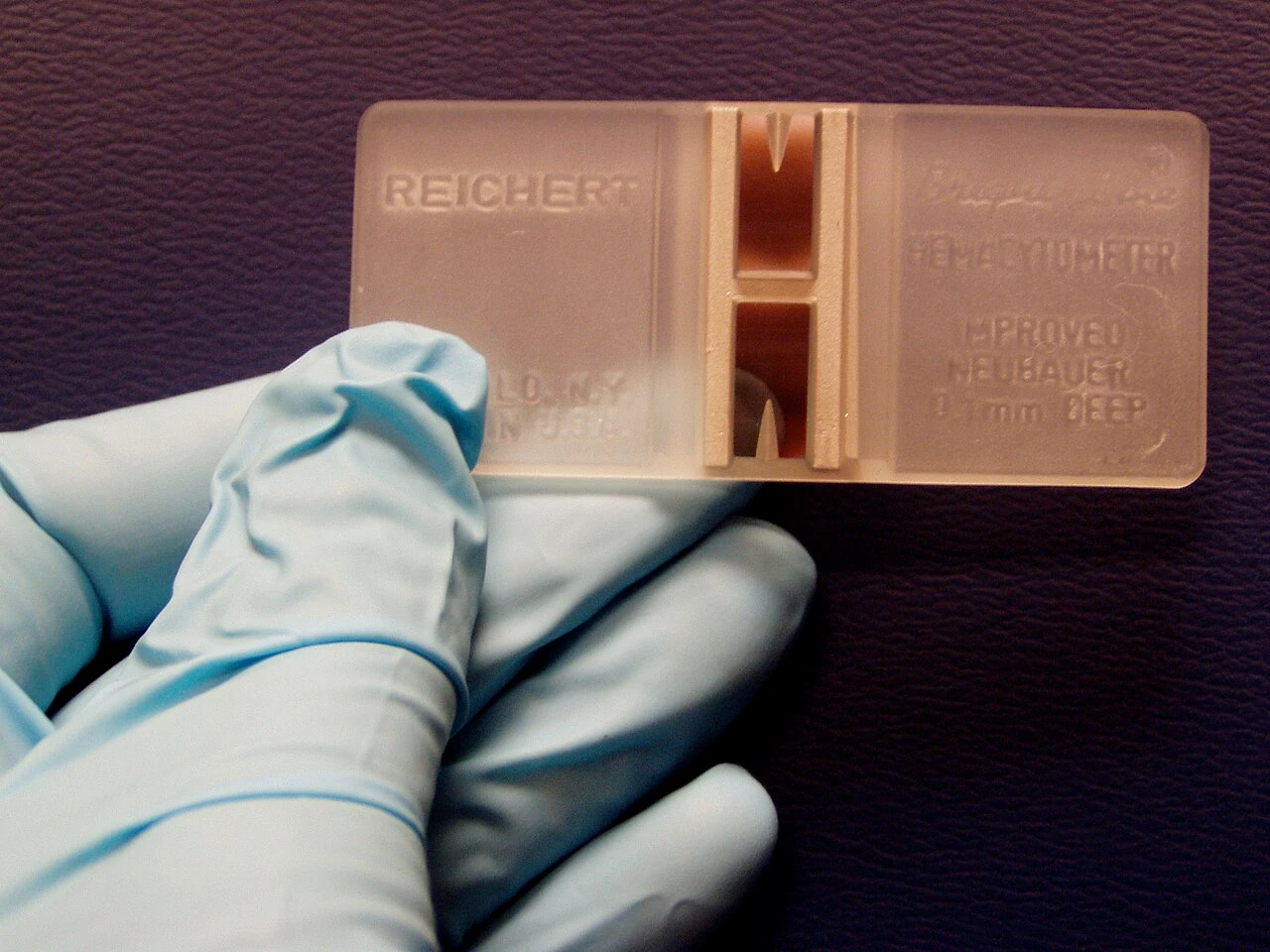
Counting platform: located on the reference instrument. Compare its shape and position with the apparatus used in your practical.
Zoom in, then drag to inspect. Keyboard: + / − to zoom, arrows to pan, 0 to reset. Tap the numbered markers to explore parts.
Improved Neubauer haemocytometer — reference view
Image: Jeffrey M. Vinocur · Source / original · CC BY 2.5Resized and converted to WebP; original colours retained.
Improved Neubauer haemocytometer
Counting chamber · haemocytometer · hemocytometer
What is its use?
Manually estimates cell concentration in a known volume under a microscope.
Tap a number to locate its part. Zoom, drag or use full screen to inspect the reference. Models and graduations can differ; check the actual apparatus used in your laboratory.
How to recognise it.
- Thick precision glass counting slide
- Ruled grid on a raised central platform
- Special cover glass establishes the counting depth
The haemocytometer is the counting chamber; a diluting pipette prepares a dilution and is a separate instrument.
Point them out.
Choose a part to bring its numbered marker into view.
The science behind the reading.
Concentration equals cells counted × dilution factor divided by counted volume. In an Improved Neubauer chamber the standard cover-glass depth is 0.1 mm.
Think first. Then reveal.
Explain your answer aloud before opening it.
01What is the standard chamber depth?+
0.1 mm with the specified cover glass correctly seated.
02Why is a special cover glass needed?+
It creates the calibrated chamber depth; an ordinary coverslip may give the wrong counting volume.
03What is the general counting formula?+
Cells per unit volume = cells counted × dilution factor ÷ volume counted.
04Why use a consistent boundary rule?+
It avoids counting cells on shared borders twice. Follow the same inclusion and exclusion convention throughout.
Read the references.
Teaching and clinical references are listed here. Image attribution and licence appear below the viewer.