 MEDIVEERSETHE PRACTICAL HUB
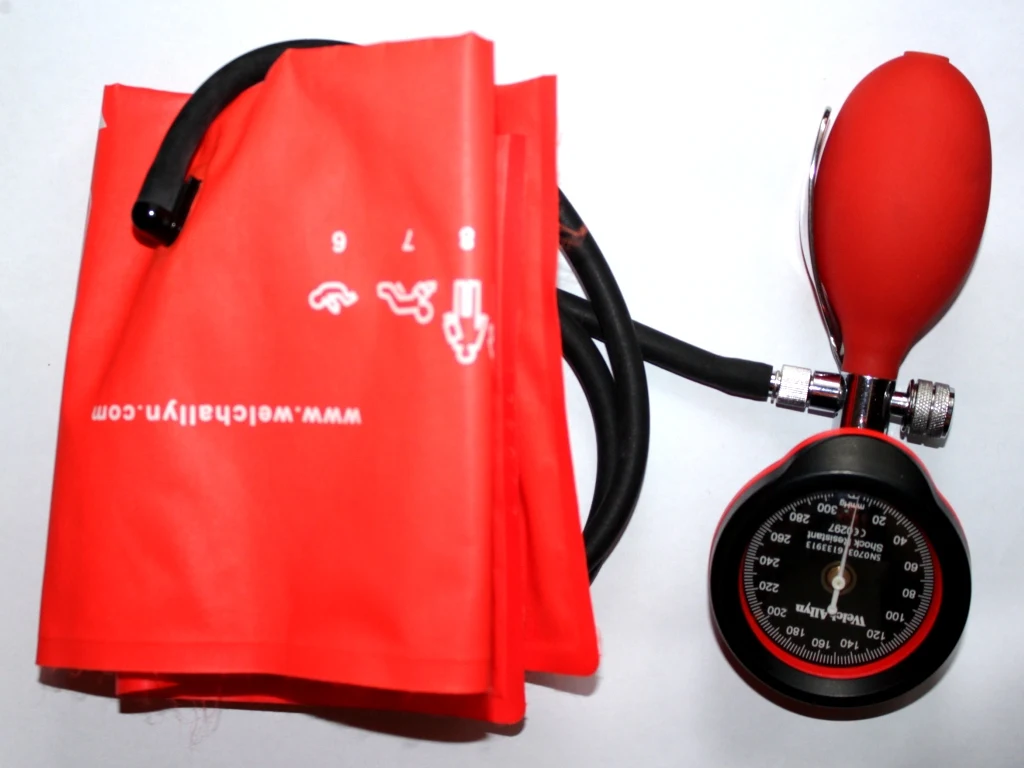
Cuff: located on the reference instrument. Compare its shape and position with the apparatus used in your practical.
Zoom in, then drag to inspect. Keyboard: + / − to zoom, arrows to pan, 0 to reset. Tap the numbered markers to explore parts.
Sphygmomanometer — reference view
Image: AfroBrazilian · Source / original · CC BY-SA 3.0Resized and converted to WebP; original colours retained.
Sphygmomanometer
BP apparatus · aneroid blood pressure monitor
What is its use?
Measures arterial blood pressure indirectly with a suitable validated method.
Tap a number to locate its part. Zoom, drag or use full screen to inspect the reference. Models and graduations can differ; check the actual apparatus used in your laboratory.
How to recognise it.
- Inflatable cuff connected to a pressure gauge
- Inflation bulb with a release valve
- Gauge is commonly calibrated in mmHg
A stethoscope detects sounds; the pressure gauge measures cuff pressure. An automated oscillometric monitor derives values by another method.
Point them out.
Choose a part to bring its numbered marker into view.
The science behind the reading.
Cuff pressure is related to arterial flow changes. In manual auscultation, Korotkoff sounds identify systolic and diastolic endpoints.
Think first. Then reveal.
Explain your answer aloud before opening it.
01What does the first Korotkoff sound indicate?+
The conventional auscultatory systolic pressure endpoint.
02What does disappearance of sounds usually indicate in adults?+
Korotkoff phase V, the usual diastolic endpoint.
03Why does cuff size matter?+
An unsuitable cuff can bias the measured pressure; select a cuff appropriate to arm circumference.
04Why support the arm at heart level?+
A height difference introduces a hydrostatic pressure error.
Read the references.
Teaching and clinical references are listed here. Image attribution and licence appear below the viewer.