Identify the reference
Inflatable cuff connected to a pressure gauge. Inflation bulb with a release valve. Gauge is commonly calibrated in mmHg
 MEDIVEERSETHE PRACTICAL HUB
LOOK CLOSELY / UNDERSTAND CLEARLY
Explain reliable bedside blood-pressure measurement and context-sensitive interpretation.
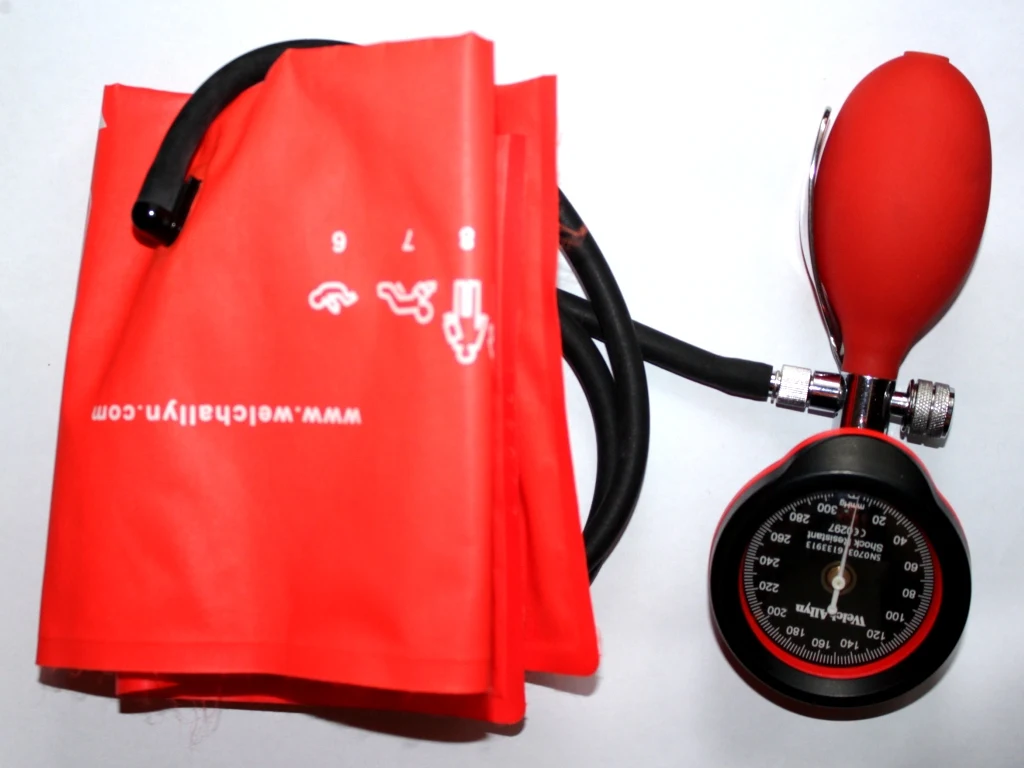
Cuff: located on the reference instrument. Compare its shape and position with the apparatus used in your practical.
Zoom in, then drag to inspect. Keyboard: + / − to zoom, arrows to pan, 0 to reset. Tap the numbered markers to explore parts.
Sphygmomanometer — reference view
Image: AfroBrazilian · Source / original · CC BY-SA 3.0Resized and converted to WebP; original colours retained.
Cuff pressure is related to arterial flow changes. In manual auscultation, Korotkoff sounds identify systolic and diastolic endpoints.
Inflatable cuff connected to a pressure gauge. Inflation bulb with a release valve. Gauge is commonly calibrated in mmHg
Cuff pressure is related to arterial flow changes. In manual auscultation, Korotkoff sounds identify systolic and diastolic endpoints.
Technique, cuff size, repeated observations and clinical status affect interpretation.
Try answering aloud, then open the suggested answer. Examiner questions vary.
The conventional auscultatory systolic pressure endpoint.
Korotkoff phase V, the usual diastolic endpoint.
An unsuitable cuff can bias the measured pressure; select a cuff appropriate to arm circumference.
A height difference introduces a hydrostatic pressure error.