Orient
Identify the recorded arch and negative tooth surfaces.
 MEDIVEERSETHE PRACTICAL HUB
OBSERVE / REASON / EXPLAIN
Assess a recorded impression for its intended prosthodontic task and explain visible limitations.
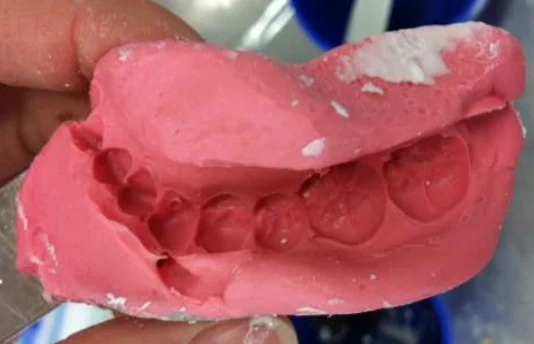
A negative reproduction of a tooth surface in the impression.
Zoom in, then drag to inspect. Keyboard: + / − to zoom, arrows to pan, 0 to reset. Tap the numbered markers to explore parts.
Alginate impression — reference specimen
Image: ANUG · Source / original · CC BY-SA 3.0Resized and converted to WebP; original colours retained.
An irreversible hydrocolloid sets through a chemical reaction; handling and storage affect dimensional accuracy.
Identify the recorded arch and negative tooth surfaces.
Look for tears, voids, incomplete coverage and tray separation.
Use the manufacturer’s time and storage guidance before cast production.
Try answering aloud, then open the suggested answer. Examiner questions vary.
A negative reproduction.
No. Dental alginate is an irreversible hydrocolloid.
Defects may transfer to the cast and affect later work.
No. A new accurate record may be required.